ゴジラ
Godzilla
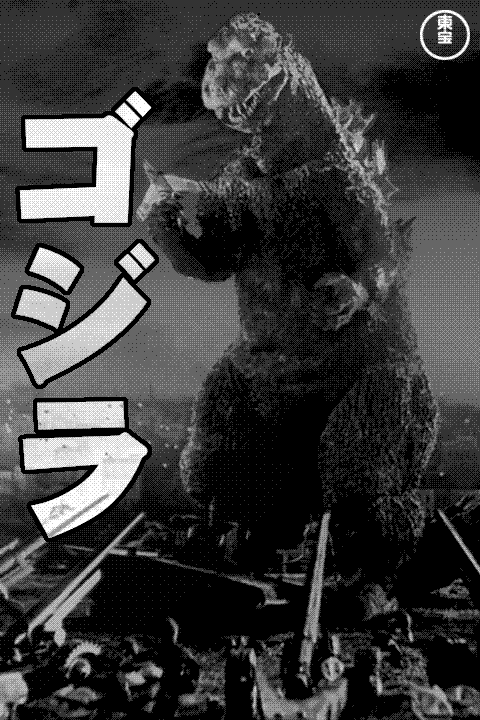
Release Date: November 3rd, 1954
Run Time: 96 minutes
Producer: Tomoyuki Tanaka
Writers: Shigeru Kayama (Story), Takeo Murata, Ishiro Honda (Screenplay)
Directors: Ishiro Honda (Dramatic), Eiji Tsuburaya (Special Effects)
Composer: Akira Ifukube
People
Dr. Daisuke Serizawa - Akihiko Hirata
Dr. Kyohei Yamane (The Professor) - Takashi Shimura
Hideto Ogata (The First Guy) - Akira Takarada
Emiko Yamane (The Pivot) - Momoko Kochi
Hagiwara (The Reporter) - Sachio Sakai
Shinkichi Yamada - Toyoaki Suzuki
Masaji Yamada - Ren Yamamoto
Bit Parts: Kenji Sahara (Take a Shot!), Haruo Nakajima, Katsumi Tezuka, Solomon Hirose, Ishiro Honda (allegedly)
Monsters: Godzilla (1st Generation), late surviving trilobites that are never elaborated on or mentioned again
Mecha: Tanks (M24 Chaffee), Jet Fighters (F-86 Sabre), Frigates (Kusu Class), etc.
Act I
The fishing vessel Eiko-Maru sends out an urgent SOS after being attacked out at see. A rescue ship sent out to the coordinates suffers the same fate. As the sea continues to mysteriously swallow up ship after ship, a single survivor washes ashore on his home of Odo Island, claiming that something sunk his ship. Hagiwara flies to the island to interview the survivor, Masaji, and the other islanders, and discovers the local legend of Godzilla, a sea monster that was placated with human sacrifice in times so distant even the village elder only remembers it as a story from his youth. That night, the something comes onto the island to collect the life of the one sailor who managed to get away.
Act II
An investigatory party heads to Odo Island from Tokyo, this time including the paleontology Dr. Yamane, who in sequence discovers a recently deceased (as in, this geological era) trilobite, traces of Strontium-90, and then, of course, Godzilla. Back in Tokyo, a presentation on what little he knows aboot the monster causes an uproar in the Diet when the obvious conclusion - that Godzilla is a product of nuclear weapons testing by the United States - rattles the post-occupation politicians. The newly formed JSDF is deployed for the first time to attack Godzilla with depth charges, much to the dismay of Yamane, who laments that the key to survivng the atomic age may die with the creature unleashed by it if it is successfully eradicated. It is, of course, not. Meanwhile, after Hagiwara fails to convince Dr. Serizawa to spill the beans on his current research, Serizawa instead reveals it to Emiko, his arranged marriage fiance and Dr. Yamane's daughter, under a strict NDA agreement. Godzilla briefly comes ashore in Tokyo, proving to be seemingly invulnerable and capable of destruction on a level not seen since the end of the war.
Act III
After an unknown amount of time, construction finally finishes on a massive barrier of electical towers and power lines surrounding the coast of Tokyo Bay, with the hope being that Godzilla will be electrocuted to death if it surfaces again. Guess how that goes. Godzilla walks through everything the JSDF can throw at them, and reveals an atomic death ray which engulfs the capital in a raging nuclear inferno. Godzilla only leaves of their own volition, and the aftermath is grim. Realizing both what the monster is capable of and how untouchable it is, Emiko decides to break her NDA and enlist her boyfriend, Ogata, into convincing Dr. Serizawa to use his terrible discovery - the Oxygen Destroyer - as the last remaining hope to destroy Godzilla. Serizawa agrees but only under the condition that this will be the only time it is ever used, in order to avoid a repeat of what happened when the bomb was unleased on the world. Ogata and Serizawa dive down to find Godzilla sleeping at the bottom of Tokyo Bay, and Serizawa cuts his own line before activating the weapon, killing Godzilla and giving the two lovers a chance to live "happily." Dr. Yamane, being both a total bummer and a sequel hook, isn't convinced that Godzilla was the only one of his kind.







The sequels that followed were simply sequels, even as the continuity became more and more confused as Toho built up what would today be called a "cinematic universe" in the pre-home video era. This changed with the 30th anniversary film, also just titled Godzilla, which is really confusion, but better known as Return of Godzilla. This wasn't a full reboot but rather a direct sequel to the original film, which set a precedent which would be followed for the next 30 years. Because of this, the original 1954 film is a kind of patient zero from which all other series spin off from up until the SJHU. This is the 1954 Continuity Family and it encompases almost every single monster or sci-fi or w/e else film Toho has ever made, thanks to Godzilla's long reach and central placement in the various continuities of these films. Not only is it almost always present, but it is also often the only film the various branches of the 1954 Continuity Family have in common. Because of that, what follows is a rundown of each of the Godzilla films relate back to the original:
Showa Timeline: The second film is a direct sequel, and this follows in a pretty straight forward way up until the Showa 40's. While the expectations of audience of the time meant that you were never going to get the kind of rigid continuity you see today under any circumstances, the only real inconsistencies with the original film as the series wore on in this continuity was the tone shift. It's weird to think that the name "Godzilla" refers to both the monster that brought the world kicking and screaming into its final act and the monster of justice who shakes hands with kyodai heroes... but it's technically not a discontinuity!
VS Series: This was the beginning of Toho caring aboot continuity, and it stays consistent throughout the entire run of films from the 80's and 90's. While the continuity of other monsters from the original timeline create weird ghost lineages, the treatment of the events of the original Godzilla film and its effects on the world in this timeline are consistent until the end, with the last of the series, Destroyah, establishing that the Oxygen Destroyer, like the bomb before it, created its own mutant monster in the form of the title antagonist. Which means that Destroyah should show up in every timeline in the 1954 Continuity Family, but I don't think we're meant to think aboot that.
Godzilla 2000: This film has no continuity references to any previous Godzilla film other than the part where Godzilla is a thing that exists, and has been aroond for... some amount of time. Promotional materials establish that the Millennium Godzilla is a second Godzilla and that the film does take place after the original, which seems fairly obvious, but again, nothing in the film actually corroborates that other than the familiarity. Around the time of the US theatrical release the film was sometimes said to take place after the original film and the 1984 film, but where this comes from I have no idea, and it doesn't really make a lot of sense.
Godzilla X Megaguirus: This is the weirdest one of all because the cold open replicates footage of the events of the original film, but super-imposing the new Millennium Godzilla into the scenes. Additionally, the exposition tells us that Godzilla was never destroyed and simply left, meaning in this timeline we're not really looking at a sequel to the actual original film itself, but rather an alternate history version of that film. What's really weird (and frustrating) is that while the film features the same individual Godzilla with the same stats and powers and appearance and all that, it isn't in continuity with Godzilla 2000, since the Tokai Nuclear Power Plant is still operational in 1999 in that film, while Godzilla's attack on it in 1966 in GxM caused nuclear power to be banned outright ever since. Another weird fridge... horror? aspect of this situation is that in this timeline, the 1st generation Godzilla seems to just have never existed at all, and the Millennium Godzilla appears to be the only Godzilla.
GMK: There is some confusion over whether the ghost-zombie-Godzilla in this film is meant to be the original Godzilla resurrected, or a second Godzilla. Some promotional materials claim it's a second individual, but the film itself never gives any indication of this, and is dead set on presenting Godzilla's resurrection as a symptom of the war crimes of WWII, this time Japan's specifically. Either way, the film is another direct sequel which is entirely consistent with the original, albeit with an added Ring-esque supernatural element which was very in vogue at the time. This film also does something new by explicitly including the entirety of another previous monster movie into its continuity, but a non-Godzilla one, this time being the original Zilla film from 1998. Other continuities have connections to previous films in some aspects, but this was the first time a Godzilla film ever singled out a non-Godzilla film in its exposition in the same manner.GMMG: Again it's another simple continuation of the original film that respects its continuity. With one minor exception: the Oxygen Destroyer never dissolved Godzilla's bones. In addition, the Kiryu films up the ante from GMK by referencing multiple non-Godzilla Toho monster films as being part of its continuity. However this is a little confused too, as the films themselves have some weird inconsistencies with the continuity of these non-Godzilla films, and tie-in hobby books expanding on the timeline of the films were likewise contradictory and confusing. However, while the exact nature of the duology's continuity with these non-Godzilla films is a little ambiguous, its connections to the 1954 Godzilla are very straightforward. They even filmed new footage of the 1st generation Godzilla for a flashback sequence, marking the second ever appearance of this particular Godzilla in a film!
Final Wars: Continuity-wise Final Wars is a weird bird. It was written to be a sequel to the VS series, and still includes continuity connections to it, and it does reference the original Godzilla appearing in 1954, but outside of that the finished film kinda leaves you out to dry. However, since the original film is also in-continuity with the VS series, this makes all of the orphaned continuity nods point back to the original, so it definitely happened. But outside of that, the continuity is a mess.SJHU: This is the first time that the original film is explicitly not in continuity, as Shin is the series first full reboot, ignoring the weird alternate-universe history of GxM. However, elements of the 1954 Continuity Family are still present, such as the origin of the name being from an Odo Island legend, the character of Goro Maki, that Godzilla was first discovered in the mid 50's, and the fact that Godzilla's earlier stages look exactly like a horribly deformed and mutated Godzillasaurus. Shin Godzilla is a film that encourages familiarity while simultaneously capable of supporting its own weight with its completely fresh take.
AniGoji: Another full reboot, but again mythology nods are present with Godzilla's name again coming from Odo Island mythology, and the monster being named by a character named Yamane. However this is clearly a different creature because it's more Biollante than Godzilla. This unique take doesn't extend to the prequel novels, where monsters appear in most cases exactly the same as previous appearances in the 1954 Continuity Family films. The merger of new and familiar is very strange, especially when the other returning monsters in the films who have major parts - Mothra, Ghidorah, and Mechagodzilla - are likewise almost entirely consistent with their 1954 Continuity Family origins, just in a very, uh, I think the kids call it "extra" way.Minus: Taking place before the original film it obviously can't be too close. However, that aside, it is in every other aspect completely consistent with the 1954 Continuity Family with respect to what Godzilla and Godzillasaurs are. How far these connections will reach remains to be seen, as the sequel isn't due until 2026.
The Basic Idea: World War II, firebombing, nuclear weapons, & the Castle Bravo test
The Big Idea: The universe has become aware of its own mortality
One of history's greatest, most endearing, and objectively true highdeas is that sentient creatures - including us - are the universe experiencing itself. This was probably most famously introduced to the world via the world's greatest stoner, Carl Sagan. I assume. It is literally true that "the universe" refers to the totality of our... everything, this physical space we inhabit, the stars, space, matter, time, and that is the material from which all living things are made and the space we inhabit. The universe is made of things which have the ability to look out at itself and question its own existence. Imagine then what would happen when the universe invents the bomb, and as a result, already has the predictive powers capable of producing such a technology, meaning that the universe is also well aware of the consequences of what its doing. The universe isn't just experiencing itself anymore, because ever since 1945, the universe has had to grapple with its own inevitable death.
The big idea isn't that nukes alone are capable of destroying everything, of course. "Everything" is simply too many things. But it can destroy us, and therefore, the universe's ability to experience. Once you strip away the specifics of the thing, the skeleton is actually far more horrifying, because the story of Godzilla isn't simply that of the bomb, because the film doesn't end with the bomb, it ends with the Oxygen Destroyer, which doesn't exist. Yet. While the film pushes the imagery of war that was still fresh in the minds of the survivors, and wrapped itself up in the zeitgeist of the reality of what the bomb means, it didn't rest on its laurels and settle on that being the only threat. The pattern that forms between the bomb and the Oxygen Destroyer is that of a living thing constructing its own execution machine. Living things yearning for death so badly they'll do anything to hasten its coming, even if they have to build it themselves.
Honda was the son of a Buddhist monk and a strong pacifist and humanistic person all his life, but he just happened to have been of age during war time, which challenged him and, frankly, broke him. While the later Honda films during the Showa 30's in the wake of the post-war economic miracle are a testament to a Honda with a second lease on life and the means to express his vision of a world that could be if we keep picking up the pieces and valuing life more than death, this first film has none of that. This film is an expression of Honda at his most pessimistic, and it relishes it its own misery in a way few other Godzilla films ever bother to.
If you really consider all of the effort that went into the atrocities that made Godzilla possible, all of the hate, the engineering, the research, manufacturing, strategy, raw materials, and on and on and on, it's simply incredible how much effort human (and nazi) civilization put into creating the myriad of horrors Godzilla depicts. What creature would ever have so much determination to kill itself, knowing that it was the only end result of all of its combined actions? The reality is that of course we were not all complicit in this, that most of us were just trying to survive as normal, like Honda was before he was drafted. But now that Godzilla is here, there's no going back for any of us now, and all that's left to do is wait until its our turn for the monster to take us. This is the skeleton that Godzilla's flesh is wrapped aroond, which will keep regenerating for as long as that skeleton remains intact, and the skeleton can no longer be put back in the box. Art aboot the horrors of the war and particularly the bomb had existed prior to Godzilla, but it was this film, this name, that gave a tangible form to the collective anxiety that followed as a result of the tipping point that occurred in 1945. The birth of Godzilla and the beginning of the end of human civlization, both extensions of the universe's confrontation of its own mortality.
Godzilla the Draft
This version is very different.
Godzilla in English
This version is very different.